
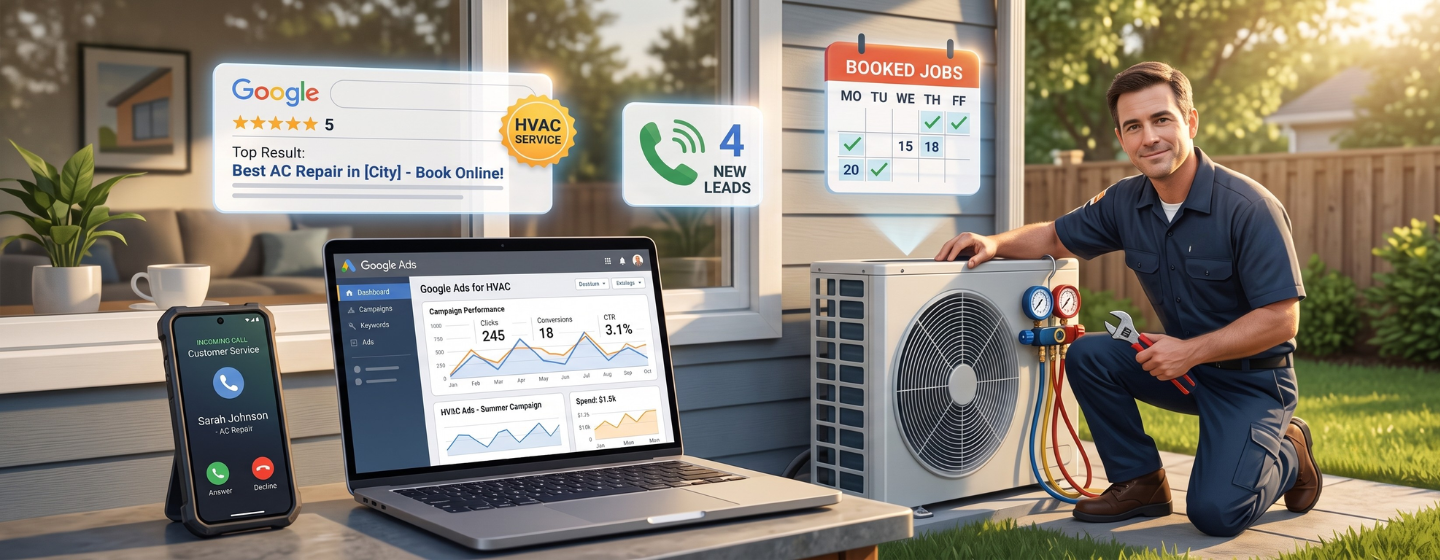
Google Ads for HVAC Companies: How to Get More Calls & Booked Jobs
The problem is that many HVAC companies waste ad spend on broad keywords, weak landing pages, poor conversion tracking, and low-quality leads. A campaign can get clicks and still fail if it does not generate real booked jobs.
This guide explains how HVAC companies can use Google Ads to get more phone calls, service requests, maintenance leads, replacement opportunities, and booked appointments. You’ll learn how to structure campaigns, choose keywords, manage budgets, improve lead quality, and track results properly.
For HVAC companies, the goal is not just more clicks. The goal is more qualified calls, more booked jobs, and more profitable service and replacement opportunities.
Why Google Ads Works So Well for HVAC Companies
Google Ads works for HVAC because it captures demand at the exact moment a homeowner or business needs help. Someone searching “AC repair near me,” “emergency HVAC service,” or “furnace repair today” is showing clear buying intent. They are not casually browsing. They are looking for a provider now.
This is different from many social media campaigns, where people may see an ad before they need service. Social can support awareness and remarketing, but Google Search is especially strong for urgent and high-intent HVAC searches.
HVAC also has strong seasonal demand. AC repair and replacement searches usually increase during warmer months, while furnace repair and heating service rise during colder months. Google Ads allows you to adjust budgets, ad copy, and campaign focus based on season, weather, and service priority.
Google Local Services Ads can also help HVAC companies appear at the top of local results with a Google Guaranteed style trust signal where eligible. AP reported that Google moved toward requiring verified Google Business Profiles for Local Services Ads in select regions, making profile accuracy and verification more important for local advertisers.
Pro Tip: HVAC advertising should be built around urgency, seasonality, service value, and local trust. A generic PPC campaign will usually underperform against a campaign designed specifically for HVAC search intent.
Best Google Ads Campaign Types for HVAC Companies
HVAC companies should not rely on one campaign type only. The best structure often includes Google Search Ads, Local Service Ads, brand campaigns, remarketing, and sometimes Performance Max after conversion tracking is strong.
Search campaigns are usually the foundation because they target high-intent keywords. Local Service Ads can generate local phone calls and build trust. Remarketing can bring back visitors who researched services but did not call. Performance Max can support additional reach, but it should be tested carefully because lead quality can vary.
| Campaign Type | Best Use | Strength | Risk |
|---|---|---|---|
| Search Ads | AC repair, furnace repair, emergency service | High intent and keyword control | Can be expensive without negatives |
| Local Service Ads | Local calls from verified service areas | Trust and top placement | Less keyword control |
| Brand Search | Protect business name searches | Low-cost high-intent traffic | Limited volume |
| Remarketing | Re-engage website visitors | Useful for replacement and maintenance | Needs audience size |
| Performance Max | Scale after tracking improves | Multi-channel reach | Lead quality can vary |
For most HVAC companies, the best starting point is Search Ads and/or Local Service Ads. Once tracking is accurate and campaigns are producing quality calls, you can test additional campaign types.
Pro Tip: Do not start with every Google Ads campaign type at once. Start with high-intent Search and LSA, then expand after you know which services, locations, and keywords produce booked jobs.
HVAC Keywords That Drive Calls and Booked Jobs
Keyword strategy can make or break HVAC Google Ads performance. HVAC companies should focus on keywords that show immediate service intent, not broad research intent.
Strong HVAC keywords often include:
– AC repair near me
– air conditioner repair
– emergency AC repair
– HVAC repair near me
– furnace repair near me
– heating repair service
– HVAC company near me
– AC installation
– HVAC replacement
– ductless mini split installation
– commercial HVAC repair
Weak or risky keywords may include:
– HVAC jobs
– HVAC training
– HVAC school
– how to fix AC
– DIY furnace repair
– HVAC salary
– HVAC certification
– free HVAC estimate template
| Keyword | Intent Level | Recommended Action |
|---|---|---|
| emergency AC repair near me | Very High | Prioritize with call-focused ads |
| furnace repair today | Very High | Prioritize during heating season |
| HVAC company near me | High | Use local landing page |
| AC installation cost | Medium-High | Use replacement-focused page |
| how to fix AC | Low | Usually exclude or separate as SEO content |
| HVAC jobs | Wrong Audience | Add as negative keyword |
Use phrase and exact match for high-intent terms first. Broad match can be tested later, but only with strong conversion tracking, call quality review, and negative keyword management.
Pro Tip: For HVAC lead generation, keyword quality matters more than keyword quantity. A small group of high-intent keywords can outperform hundreds of broad, low-intent terms.
Build Campaigns by Service, Season, and Location
A common HVAC PPC mistake is putting every service into one campaign. AC repair, furnace repair, duct cleaning, maintenance plans, replacements, and commercial HVAC have different intent, different value, and different seasonality.
Better campaign structure gives you more control over budget, ad copy, and reporting. For example, AC repair campaigns may need higher budgets during summer heat waves, while furnace repair campaigns may need more budget during colder months. Replacement campaigns may need different ad copy and landing pages because the customer journey is more considered and higher value.
| Campaign | Purpose | Example Landing Page |
|---|---|---|
| AC Repair Search | Emergency and repair calls | /ac-repair/ |
| Heating / Furnace Repair Search | Cold-weather repair leads | /furnace-repair/ |
| HVAC Installation / Replacement | Higher-value system leads | /hvac-installation/ |
| Maintenance Plans | Recurring service and tune-ups | /hvac-maintenance/ |
| Commercial HVAC | B2B facility and business leads | /commercial-hvac/ |
| Brand Search | Protect brand demand | Homepage or contact page |
Location structure also matters. If some cities produce better jobs, higher close rates, or larger average tickets, budget should shift toward those areas. Poor-performing ZIP codes should be reduced or excluded.
Pro Tip: Segment HVAC campaigns by service value. A $99 tune-up lead should not be optimized the same way as a $12,000 replacement opportunity.
Use Call-Focused Ads and Landing Pages
HVAC buyers often want to call. If your ads and landing pages make calling difficult, you will lose jobs to competitors.
Google Ads allows advertisers to track calls from ads and calls from websites, which is critical for HVAC companies because many leads happen by phone. Call assets, location assets, mobile-friendly landing pages, and clear phone CTAs should be part of your strategy.
Your landing page should immediately answer the visitor’s main questions:
– Do you service my area?
– Can you help today?
– Are you licensed and insured?
– Do you have good reviews?
– How do I call or book service?
– Do you handle my HVAC issue?
High-Converting HVAC Landing Page Checklist:
– Service-specific headline
– Click-to-call phone number above the fold
– Short form for service requests
– Same-day or emergency service message where true
– Reviews and trust badges
– Financing mention for replacements where applicable
– Service area list
– Photos of real technicians or vehicles
– Clear CTA buttons
– FAQ section
– Fast mobile load time
Mid-Blog CTA:
Want us to audit your current campaigns? Book a free strategy call at namasteadvertising.com and we’ll review your HVAC keywords, calls, landing pages, tracking, and wasted spend.
Pro Tip: For mobile HVAC traffic, the phone number is not a design detail. It is the conversion path. Make it highly visible and easy to tap.
Track Calls, Booked Jobs, and Revenue — Not Just Leads
A successful HVAC Google Ads campaign should not be judged only by clicks or form fills. The real question is: how many calls turned into booked jobs, and how much revenue did those jobs produce?
Many HVAC companies waste money because they track every lead equally. A wrong-number call, job seeker, service-area mismatch, and booked replacement estimate are not the same. Your tracking should separate real business opportunities from low-quality activity.
| Metric | Why It Matters | Optimization Use |
|---|---|---|
| Call volume | Shows demand generated | Measure campaign response |
| Qualified calls | Filters out bad leads | Improve keyword and location targeting |
| Booked jobs | Shows real business impact | Optimize toward appointments |
| Cost per booked job | More useful than cost per lead | Evaluate profitability |
| Average ticket value | Shows revenue potential | Prioritize high-value services |
| Close rate | Measures sales follow-up quality | Identify sales or lead quality issues |
You should connect Google Ads, call tracking, GA4, and CRM or booking data where possible. This helps you understand which campaigns produce real revenue, not just activity.
Pro Tip: Listen to call recordings if legally allowed in your area and properly disclosed. Call quality review can reveal whether the issue is targeting, pricing, dispatch availability, or call handling.
Budget Strategy for HVAC Google Ads
HVAC Google Ads budgets depend on market size, CPCs, competition, seasonality, and revenue goals. A small local HVAC company may start with $3,000–$7,500 per month, while a competitive metro market or multi-location company may need $10,000–$30,000+ per month.
The key is not only how much you spend, but where the budget goes. A campaign should prioritize high-intent services, profitable locations, and seasonal demand.
| Monthly Budget | Recommended Focus | Best For |
|---|---|---|
| $2,500–$5,000 | Core repair keywords in tight service area | Small local HVAC companies |
| $5,000–$10,000 | Repair + replacement + LSA testing | Growing local companies |
| $10,000–$25,000 | Multi-service campaigns and seasonal scaling | Competitive markets |
| $25,000+ | Multi-location, replacement, commercial, remarketing | Regional HVAC companies |
Budget should also shift by season. During extreme weather, HVAC search demand can spike quickly. Campaigns should be ready with higher budgets, stronger call ads, emergency service messaging, and schedule adjustments.
Pro Tip: If budget is limited, do not advertise every service. Start with the highest-margin, highest-intent service categories first.
Rich Media Plan: Infographic, Seasonal Chart, and Visual Assets
| Month | AC Repair Demand | Heating Repair Demand |
|---|---|---|
| January | Low | High |
| March | Medium | Medium |
| June | High | Low |
| August | Very High | Low |
| October | Medium | Medium |
| December | Low | High |
Conclusion — Turn HVAC Search Demand Into Booked Jobs
Google Ads can be a powerful growth channel for HVAC companies when campaigns are built around real customer intent. The best HVAC PPC strategies focus on urgent searches, service-specific campaigns, call tracking, strong landing pages, local trust, seasonal budget planning, and booked job performance.
If your HVAC campaigns are getting clicks but not enough booked jobs, the issue may be targeting, tracking, landing pages, budget allocation, or call quality.
Namaste Advertising helps service businesses build Google Ads campaigns focused on qualified calls, better leads, and real business growth.
Schedule a free PPC/SEO consultation with Namaste Advertising. Call (661) 888-0651 or visit: https://namasteadvertising.com/contact-us/
FAQs
Do Google Ads work for HVAC companies?
Yes, Google Ads work well for HVAC companies because customers often search when they need urgent repair, replacement, or maintenance. The best results come from targeting high-intent keywords, using call-focused ads, building service-specific landing pages, and tracking booked jobs instead of only clicks.
How much should an HVAC company spend on Google Ads?
In 2026, many local HVAC companies should consider starting with $3,000–$7,500 per month, depending on competition and service area. Competitive markets or companies targeting repair, replacement, and multiple cities may need $10,000–$25,000+ per month to generate consistent calls.
What are the best Google Ads keywords for HVAC?
The best Google Ads keywords for HVAC include high-intent terms like “AC repair near me,” “emergency HVAC service,” “furnace repair near me,” “HVAC company near me,” and “AC installation.” Avoid or exclude job seeker and DIY terms like “HVAC jobs,” “HVAC training,” and “how to fix AC.”
Should HVAC companies use Local Service Ads or Search Ads?
HVAC companies should often use both Local Service Ads and Google Search Ads. Local Service Ads can help generate trusted local calls, while Search Ads provide more keyword control, landing page control, and detailed optimization for specific HVAC services.
How can HVAC companies get more calls from Google Ads?
The best way to get more calls from Google Ads is to target urgent repair keywords, use call assets, show phone numbers above the fold, improve mobile landing pages, run ads during service hours, and track call quality. Campaigns should optimize toward booked jobs, not just clicks.
Why are my HVAC Google Ads getting clicks but no booked jobs?
Your HVAC Google Ads may get clicks but no booked jobs because of weak landing pages, poor keyword targeting, irrelevant search terms, missing call tracking, slow response times, or bad service-area targeting. A full PPC audit can identify where the budget is leaking.
What should HVAC companies track in Google Ads?
HVAC companies should track phone calls, form submissions, qualified calls, booked jobs, cost per booked job, average ticket value, and revenue. Tracking only clicks or basic leads is not enough to understand true campaign profitability.