
What Is Remarketing in Google Ads? How to Bring Back Lost Leads and Maximize Abandoned Traffic
If you fail to re-engage these users, those clicks are gone forever, your customer acquisition costs spike, and your budget bleeds into empty traffic.
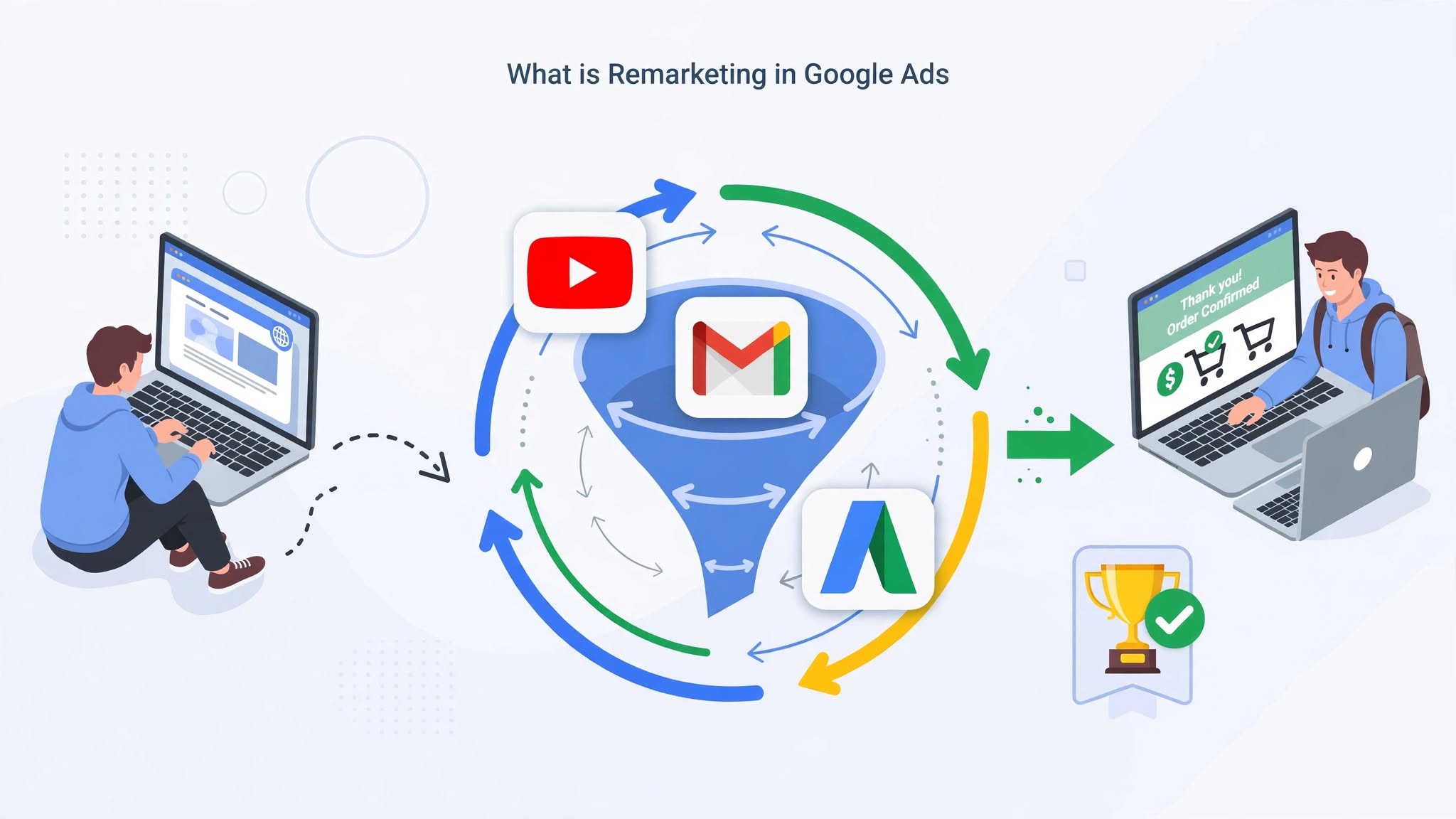
This is where understanding what is remarketing in google ads completely shifts the economics of your digital marketing campaigns. First-time website visitors rarely convert immediately because they are evaluating multiple solutions, reviewing competitor pricing, or simply getting distracted. Remarketing (often called retargeting) allows your business to drop a secure tracking cookie or capture a first-party data event, enabling you to display targeted ads to those exact individuals as they browse other sites across the internet. Instead of letting interested prospects slip away, you build a strategic bridge to bring them back down your conversion funnel.
As an elite digital marketing and performance agency based in Santa Clarita, CA, Namaste Advertising has engineered and scaled complex multi-channel lead pipelines for high-ticket service brands and growing organizations. This definitive guide breaks down the technical mechanics, privacy standards, audience segments, and ad creative frameworks required to turn cold, abandoned website traffic into a predictable engine for closed revenue.
1. The Behavioral Framework: Why First-Time Clicks Rarely Convert
To deploy a highly profitable remarketing campaign, your leadership team must first understand consumer psychology and user behavior. In a crowded digital marketplace, a prospect typing a transactional long-tail keyword string into a search engine is gathering intelligence. They may click your ad, read your value proposition, and leave—not because they disliked your service, but because they are in the commercial research phase of their buying journey.
Forcing a prospect to make an immediate, high-ticket buying decision on their very first interaction creates psychological friction. They need social proof, case studies, and brand familiarity before they feel secure sharing their contact credentials or booking a discovery call. Remarketing serves as an automated follow-up engine, ensuring your brand stays top-of-mind while they evaluate their options.
Critical Performance Benchmark: Cross-industry paid media data demonstrates that remarketing audiences yield an average click-through rate 2x to 3x higher and an overall conversion rate up to 150% greater than cold, top-funnel search campaigns because you are messaging a pre-qualified pool of users who already recognize your brand asset.
By shifting your advertising strategy to recognize that customer acquisition is a multi-touch journey rather than a single event, you optimize your total search return on investment. You use your upfront search budget to capture interest, and deploy low-cost remarketing impressions to handle the nurturing process, maximizing your bottom-line profitability.
Pro Tip: Do not show the exact same ad copy to your remarketing audience that you used in your top-funnel search campaigns. They already know who you are and what you do. Your remarketing ads should focus heavily on resolving specific buying objections by showcasing five-star reviews, detailing custom client case studies, or introducing limited-time promotional offers.
2. The Technical Blueprint: How Remarketing Tracks and Categorizes Traffic
The backend execution of a remarketing list relies on clean code tracking infrastructure. When an individual lands on your website via a paid search click or an organic search result, an automated tracking snippet—known as the Google Tag—records their behavior and appends their anonymized profile to a specific Audience Segment inside your Google Ads account interface.
As that user leaves your domain and explores the web, Google’s real-time auction engine recognizes their unique audience tag. When they watch a video on YouTube, check an article on an external news site, or open their Gmail promotions tab, your customized remarketing ad is dynamically selected to display on their screen, keeping your solutions central to their browsing experience.
The Multi-Touch Audience Retargeting Funnel
[STAGE 1: TOP-FUNNEL ACQUISITION]
│
▼
Cold User searches for your target keyword strings (e.g., “PPC Consultant Santa Clarita”)
│
▼
User clicks your Google Search Ad and lands on your dedicated landing page asset
│
▼
[STAGE 2: THE BOUNCE & IDENTIFICATION]
│
▼
User reviews your offer but leaves your site without completing your lead capture form
│
├──► Google Tag fires a first-party event signal via Google Tag Manager
└──► Profile is securely grouped into a tailored “Abandoned Lead Form” Segment
│
▼
[STAGE 3: RETARGETING DISRUPTION ENGINE]
│
▼
Prospect leaves your site and browses YouTube, Gmail, or external apps across the Display Network
│
▼
Google’s auction detects the user tag and dynamically serves your behavioral remarketing creative
│
▼
[STAGE 4: THE POST-CLICK RETURN]
│
▼
User interacts with your testimonial ad, returns to your landing page capsule, and converts
3. Strategic Audience Segmentation: Grouping Visitors by Intent Levels
A common mistake that drains remarketing budgets is treating all website bouncers identically. If you bundle every user who hits your home page for two seconds into a single master retargeting list, you are wasting ad capital on low-intent traffic. To extract maximum value from your budget, you must segment your audiences based on their exact behavior on your site.
Behavioral Audience Segmentation Architecture
Audience Segment Theme | Explicit User Action Target | Intent Level | Optimal Ad Creative Messaging Strategy |
All Website Visitors | Landed on any page on your primary corporate domain | Low | Broad brand values, general capabilities video overview, trust pillars |
Deep Content Consumers | Explored multiple service sections or spent 2+ minutes reading case studies | Medium | Specific service differentiators, white paper downloads, deep-dive guides |
Abandoned Lead Forms | Visited your target conversion page but failed to view your final thank-you page | Maximum | Five-star reviews, high-urgency promotional offers, direct call-to-action prompts |
Historical Past Clients | Successfully triggered your primary completion tags or completed a conversion | Loyalty | Upsell secondary services, request local reviews, cross-promote partner offers |
By dividing your audience pools by intent level, you can tailor your ad spend surgically—allocating higher impression caps to high-value prospects who abandoned your contact form, while using broader branding creatives for top-funnel research traffic.
4. Designing High-Converting Remarketing Creatives and Messaging Matrix
Because remarketing ads display across multi-channel environments (such as the Google Display Network, YouTube layouts, and mobile apps), your ad creative must be visually striking enough to interrupt a user’s passive browsing behavior. If your banner ads look like boring, generic corporate flyers, users will scroll past them.
Your visual assets should feature a clean design, high-contrast imagery, minimal text clutter, and an unmistakable call-to-action button. More importantly, your ad text must address specific downstream buying objections directly on the graphic, using real stats and local trust proof to convert prospects into clients.
Real-World Service Industry Examples
- Example A: High-Ticket Professional B2B Consultant
- The Strategy: A B2B firm notices that prospects bounce from their service page due to long corporate evaluation timelines. They build a remarketing ad displaying a clean video testimonial from a recognizable client, paired with a headline reading: “See How We Improved Operational Efficiency by 45%—Book a Free Audit Today.”
- The Result: The social proof breaks through choice hesitation, guiding the prospect back to a dedicated landing page to book a consultation.
- Example B: High-End Local Home Services Provider
- The Strategy: A localized contractor realizes home services leads bounce because they are comparing estimates. They launch an interactive image ad across local zip codes displaying their local review score alongside a bold offer: “Santa Clarita’s Top-Rated Team—Get $50 Off Your Diagnostic Service This Week Only.”
- The Result: The local trust signals and clear savings modifier capture the user’s attention, generating immediate inbound phone calls.
5. Post-Click Optimization: The 1:1 Attention Ratio Rule
Winning back a lost prospect with an optimized remarketing ad is only the first step in your customer acquisition funnel; your destination page experience dictates your final return on investment. If you route your retargeted traffic back to your general corporate homepage, your conversion efficiency will drop. Homepages are designed for broad brand exploration, featuring complex navigation menus and links that distract users from converting.
To maximize your returns, your remarketing ads must route users to dedicated, single-purpose landing pages that maintain a strict 1:1 Attention Ratio. This means there is exactly one primary action for the user to take: complete your lead capture form or call your phone number. By completely removing top navigation menus and external links, you eliminate the distractions that lead to high bounce rates.
Are your current digital campaigns failing to bring back lost leads?
Let our performance strategists execute a comprehensive account audit. Book a free campaign architecture call at namasteadvertising.com today.
Additionally, optimize your landing pages for mobile performance. Over 60% of display and remarketing clicks occur on mobile devices. If your landing page takes longer than 2.5 seconds to render on a smartphone screen, your mobile conversion rates will drop, wasting your retargeted traffic. Keep your code clean, remove heavy scripts, and ensure your forms support smartphone auto-fill to create a frictionless user journey.
6. Navigating Modern Privacy Regulations and Tracking Purity
Modern privacy restrictions, such as Apple’s iOS privacy updates and the ongoing phase-out of third-party tracking cookies, have fundamentally altered digital retargeting. Advertisers can no longer rely on basic browser pixels to accurately track conversions and build retargeting lists.
To future-proof your campaigns, implement first-party tracking architectures across your domains. This includes configuring Google Enhanced Conversions to pass secure, hashed customer variables back to the network, and deploying server-side tracking pipelines to bypass browser restrictions.
Additionally, leverage customer match capabilities by securely uploading your internal CRM customer lists directly to Google Ads. Passing clean, hashed email and phone data directly to the network allows the machine-learning bidding models to identify your ideal audience profiles across all platforms, lowering your customer acquisition costs.
7. Building Coordinated Search Authority Across Channels
While launching a Google Ads remarketing campaign is the fastest way to reclaim lost website leads, an elite digital marketing strategy should avoid managing paid ads in complete isolation from your organic presence. Combining high-performing paid campaigns with a strong organic foundation creates a highly resilient customer acquisition engine.
By coordinating your paid keyword performance data with your long-term Search Engine Optimization (SEO) architecture, your business can share valuable data across channels. For instance, the exact high-intent phrases identified as top-converting terms within your paid campaigns can be used to guide your content production and local lead generation models, helping you secure sustainable organic market share.
For scaling organizations and active marketing agencies, managing these complex multi-channel workflows internally can quickly stretch team capacity. Partnering with a specialized team via a premium White-Label campaign partnership framework or custom AI-driven search optimization systems provides immediate access to advanced media testing tools and deep platform expertise, helping you maximize your total search footprint.
8. The Financial ROI Blueprint: Tracking True Acquisition Efficiencies
To evaluate your remarketing performance accurately, your team must move past superficial metrics like raw impressions and look directly at your net customer acquisition costs ($\text{CPA}$). The true mathematical value of a retargeting funnel is measured by its ability to lower your aggregate campaign acquisition costs over time, using this core calculation:
$$\text{CPA}_{\text{Blended}} = \frac{\text{Spend}_{\text{Search}} + \text{Spend}_{\text{Remarketing}}}{\text{Conversions}_{\text{Search}} + \text{Conversions}_{\text{Remarketing}}}$$
Imagine a campaign where an un-audited search engine marketing strategy relies solely on top-funnel search ads. The traffic converts at a baseline 2.0%, resulting in a high Cost Per Acquisition of $250.00 across your monthly ad budget.
Conversely, by implementing a structured remarketing layer, you capture the 98% of users who initially bounced. Because remarketing inventory across the Display Network and YouTube is substantially less expensive than competitive search auctions, you can buy retargeted clicks at a fraction of the cost. Converting these return visitors at a high 8.5%+ rate instantly drives down your blended customer acquisition cost, boosting your net profit margins.
Frequently Asked Questions: Google Ads Remarketing
What is the main difference between search ads and remarketing ads in Google?
Traditional Google Search campaigns are intent-driven networks that display text ads to prospects at the exact millisecond they input a keyword query. Remarketing campaigns target users who have already visited your website, displaying banner, text, or video ads across YouTube, Gmail, and the Google Display Network to bring them back to your site.
How many website visitors do I need before I can launch a remarketing campaign?
To protect user privacy, Google Ads enforces strict minimum audience size restrictions before a remarketing list can actively trigger ads. Your selected remarketing segment must accumulate a minimum of 100 active users within the past 30 days for the Display Network, and at least 1,000 active users for Google Search and YouTube campaigns.
Can modern privacy updates and cookie blockers stop my remarketing ads from working?
Modern browser updates and ad blockers can restrict traditional tracking pixels. To prevent data loss and preserve your remarketing lists, businesses must implement advanced first-party tracking solutions, such as Google Enhanced Conversions and server-side pipelines, to securely pass data back to the network.
How often should I refresh the visual creative assets in a retargeting campaign?
Because remarketing audiences are exposed to your brand frequently across a small audience pool, they are highly vulnerable to ad fatigue. To maintain strong click-through rates and prevent ad fatigue, refresh your video and image assets every 30 to 45 days, testing new testimonials, offers, and visual layouts.
Should my business utilize both Google remarketing and Meta Facebook retargeting?
Deploying a multi-channel retargeting strategy across both Google and Meta ecosystems is highly recommended. Using the Google Tag allows you to reach prospects across YouTube and millions of external partner sites, while pairing it with social platforms ensures your brand stays visible across their social feeds, maximizing your conversion opportunities.
Reclaim Your Lost Leads and Scale Your Profits with Namaste Advertising
Stop letting interested, high-value prospects leave your website without converting. Building a highly profitable customer acquisition engine requires a technical, data-driven approach focused on clean tracking infrastructure, strategic audience segmentation, compelling ad copy, and optimized post-click experiences. If your internal team lacks the time or specialized data engineering resources to continuously monitor and tune these metrics, partnering with an experienced performance agency is the fastest way to stabilize your acquisition costs and protect your margins.
Namaste Advertising designs, manages, and scales high-performance customer acquisition engines that transform paid search traffic into predictable streams of business revenue. Whether you are an enterprise operating locally in Santa Clarita, California, or an agency looking to expand your capabilities via a dedicated White-Label campaign partnership framework, our team delivers deep analytical transparency, validated tracking implementations, and dominant marketing returns.
Ready to Launch a High-Converting Remarketing Funnel and Reclaim Your Lost Leads?
Contact Namaste Advertising today at (661) 888-0651 or visit our strategy center at namasteadvertising.com/contact-us/ to schedule your comprehensive, data-driven PPC account audit and custom lead generation consultation.