SEO vs Google Ads: Which Strategy Produces Better ROI
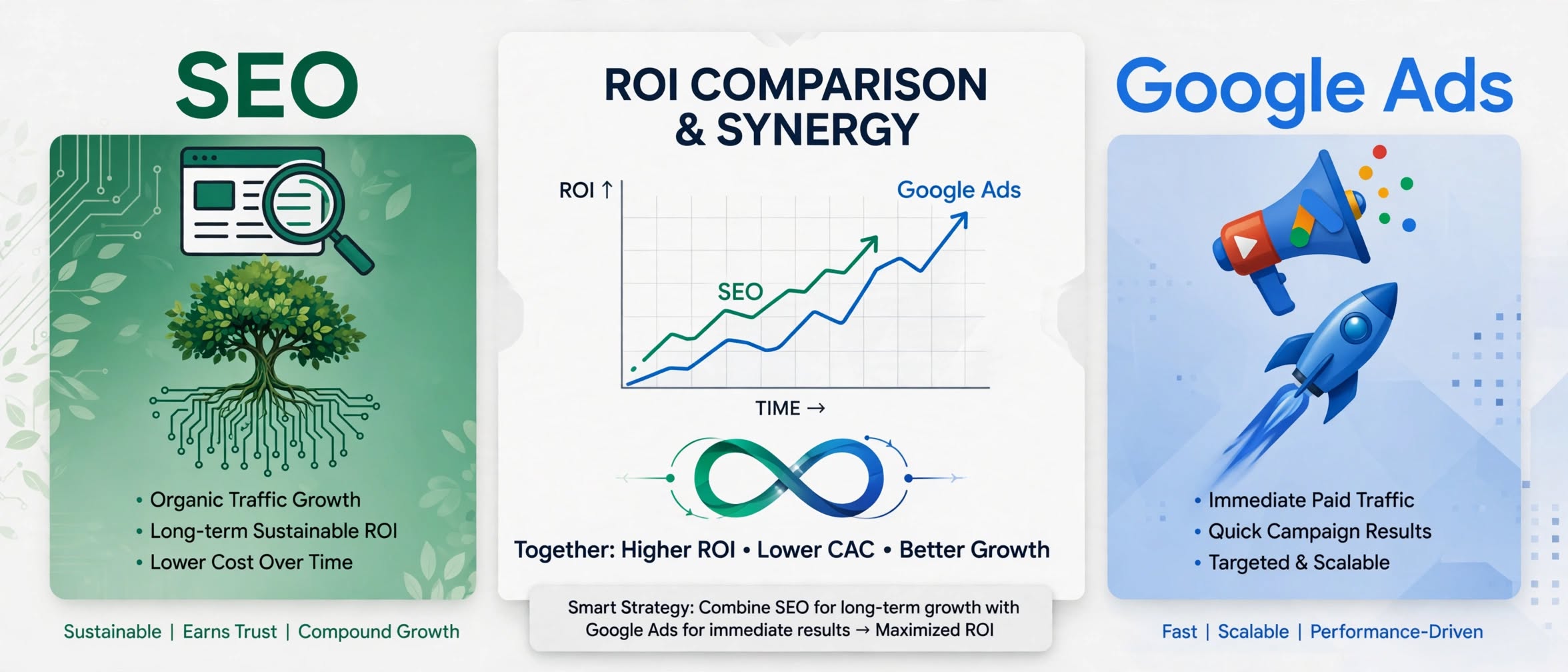
Data across premium marketing analytics platforms shows that businesses often treat organic search and paid advertising as entirely separate channels. This division creates a critical strategic mistake. While Google Ads acts as a high-speed engine that captures immediate, bottom-funnel buying intent, SEO builds a compounding equity asset that protects your brand from rising advertising costs over time.
Choosing where to focus depends entirely on your current cash flow, growth targets, and sales cycle duration. As a premier digital marketing agency based in Santa Clarita, CA, Namaste Advertising manages and scales complex multi-channel campaigns for high-ticket service brands and scaling organizations. This definitive guide breaks down the performance metrics, algorithmic shifts, and actual financial return profiles of SEO versus Google Ads in 2026, giving you a clear blueprint to maximize your marketing return on investment.
1. The Velocity Metric: Immediate Ad Real estate vs. Compounding Organic Equity
The primary operational difference between these two strategies is the time it takes to see results. Google Ads offers immediate visibility. By launching a highly optimized campaign, your brand can bypass the standard waiting period and appear at the absolute top of search engine results pages (SERPs) within hours. You pay directly for placement, giving you complete control over your traffic volume.
SEO, by contrast, relies on long-term growth and technical authority. It requires consistent technical optimization, deep content architecture, and strategic link building. While you do not pay Google for organic clicks, earning top positions takes time and consistent execution. However, once established, organic positions generate traffic continuously without a direct cost-per-click, creating a self-sustaining asset.
Critical Performance Benchmark: According to cross-industry data, the upfront cost-per-acquisition for new Google Ads campaigns is typically higher. However, an optimized SEO strategy begins to lower your average client acquisition cost after 6 to 9 months, creating a highly efficient return on investment over time.
For an organization bringing a new high-ticket offer to market or looking to hit immediate monthly lead targets, relying solely on organic search is not practical. You need the immediate traffic that paid search provides. Conversely, relying exclusively on paid ads means your lead flow stops the moment your ad budget runs out, leaving your sales pipeline vulnerable.
Pro Tip: Use a tiered rollout strategy. Launch targeted search ads immediately to capture hot prospects, while simultaneously building your foundation through high-intent keyword optimization to gradually secure sustainable, long-term organic market share.
2. Navigating the 2026 Search Interface: AI Overviews and User Behavior
The search engine environment has shifted dramatically with the integration of generative AI features, such as Google’s AI Overviews. These summaries occupy prominent space at the top of the search results, directly shifting how users find and consume information. This structural change alters how both paid ads and organic listings receive clicks.
Paid search ads remain highly visible by appearing above and within these automated summaries, ensuring immediate visibility for high-intent transactional phrases. Meanwhile, organic SEO strategy has evolved into optimization for AI platforms. To rank as a cited source within generative answers, your website must feature structured data, exceptional technical clarity, and high-authority thought leadership content.
Chart Specification: User Click Distribution Across Modern Search Layouts
- Chart Type: Clustered Horizontal Bar Chart
- X-Axis: Percentage of Total Search Clicks (0% to 50% scale)
- Y-Axis: SERP Visual Components (Paid Search Top Ads, AI Overview Conversational Citations, Traditional Organic Blue Links, Local Map Packs)
- Data Mapping Points:
- Paid Search Top Ads: 28% of total transactional clicks
- AI Overview Citations: 34% of informational & commercial clicks
- Traditional Organic Links: 21% of deep informational queries
- Local Map Packs: 17% of geo-targeted local search queries
- Design Layout Note: Use sharp blue for paid ads, deep emerald green for AI overview spaces, and slate gray for traditional links to highlight where user attention lands.
To win in this environment, your content cannot simply rehash generic information. It must provide clear, data-backed answers that search engines can easily parse and cite. Merely ranking for a keyword is no longer enough; you must focus on capturing high-value user actions.
3. The Financial Comparison: Upfront Cost-Per-Click vs. Compounding Asset Valuation
To judge financial return accurately, your team must analyze the cost structures of both models. Google Ads uses a direct transaction model: you set a daily budget, compete in real-time auctions, and pay for every click. If your conversion path or message match is unoptimized, this model can quickly drain your capital without driving revenue.
SEO requires an upfront investment in technical development, professional content writing, and site architecture. While your cost-per-click is technically zero, building that foundation requires real resource allocation. The major advantage of organic optimization is its long-term leverage; a high-performing blog post or landing page can bring in qualified leads for years without requiring ongoing ad spend.
Strategic Investment & Strategy Matrix
Performance & Cost Vector | Google Paid Search Infrastructure | Organic Search Engine Optimization |
Time to Impact | Near-instantaneous (Hours from setup to live visibility) | Gradual scaling (Typically requires 4 to 9 months) |
Payment Dynamics | Continuous Pay-Per-Click (No budget means no visibility) | Upfront operational resource asset building |
Algorithmic Stability | High control (Bids and match types determine placement) | Subject to search engine core system updates |
Conversion Efficiency | Highly transactional; targets bottom-funnel buyers | Excellent nurturing; builds trust across the funnel |
For long-term growth, the data favors a balanced approach. By using paid campaigns to fund your initial growth, you can reinvest those returns into building a strong organic asset, lowering your overall customer acquisition costs over time.
4. Lead Quality and Downstream Conversion Velocity
When comparing lead quality, paid search and organic optimization attract prospects at different stages of the buying journey. Google Ads allows you to target users displaying immediate commercial intent. When someone searches “premium digital marketing consultant” or “corporate PPC audit Santa Clarita,” they are actively looking to hire a provider, resulting in high conversion velocity.
Organic search leads often arrive through informational and commercial queries earlier in their research phase. While these prospects take longer to close, they often display deep brand loyalty because they discovered your business through educational thought leadership rather than a sponsored ad. This organic trust frequently leads to higher client retention rates.
Want us to audit your current positioning and tracking setup?
Book a free campaign strategy session at namasteadvertising.com today.
By using data-driven frameworks to analyze your customer data, you can isolate exactly which search phrases generate your highest-value clients. This clarity allows you to align your paid bidding strategy and content production with the queries that directly impact your bottom line.
5. Maximizing Conversion Paths and Post-Click Experience
Whether you focus on paid or organic acquisition, traffic is meaningless without a highly optimized post-click experience. If your landing pages feature slow load times, complex navigation, or generic messaging, your conversion rates will suffer regardless of how visitors arrive at your site.
For paid search, you need dedicated, distraction-free landing pages that exactly match the promise of your ad copy. For organic traffic, your pages should provide deep value, clear answers, and natural call-to-action prompts that guide users smoothly toward a consultation or purchase.
Optimizing your site requires regular technical maintenance. If your ad performance is dipping or your organic visibility is stalling, our specialized Google Ads optimization systems paired with advanced SEO frameworks can identify and repair the technical bottlenecks hurting your returns.
6. Protecting Performance via Modern Tracking and AI Systems
Modern privacy standards and browser updates have changed how performance data is collected. Marketers can no longer rely on simple browser cookies to track conversions or measure precise marketing return on investment across channels.
To maintain accurate measurement, your business must implement modern, first-party tracking solutions. For paid search, this involves setting up Enhanced Conversions, while organic tracking requires advanced server-side data integration. These upgrades provide automated bidding models and search algorithms with the clean data required to optimize performance.
Integrating cutting-edge AI-driven search optimization tools allows you to anticipate market shifts, monitor competitor adjustments, and optimize your content strategy automatically, ensuring your business stays ahead of search layout changes.
7. Driving Growth with Scalable Agency Frameworks
Managing both paid search and long-term organic strategies simultaneously requires substantial time, data analysis, and technical execution. For growing businesses and busy internal marketing teams, balancing these channels can easily lead to fragmented focus and inefficient execution.
Partnering with an experienced performance team allows your enterprise to scale its marketing efforts without adding fixed internal overhead. This ensures your campaigns receive constant optimization while your leadership team focuses on core operations.
Using a specialized White Label Google Ads partner framework or dedicated performance team gives you instant access to advanced tracking tools and channel expertise, helping you maximize your returns across both paid and organic search.
8. The Mathematical Blueprint: Tracking Unified Return Metrics
To accurately evaluate your search marketing performance, your team must move past surface-level metrics and calculate your Total Search Return on Investment ($ROI_{Total}$).
The true efficiency of your unified search strategy is measured using this core formula:
$$ROI_{Total} = \frac{(Revenue_{Ads} + Revenue_{SEO}) – (Spend_{PPC} + Asset_{SEO})}{(Spend_{PPC} + Asset_{SEO})}$$
Where $Spend_{PPC}$ represents your total ad spend capital and $Asset_{SEO}$ tracks your complete operational investment in content and technical site infrastructure. A healthy marketing program leverages both channels, using paid ads for consistent cash flow and organic visibility to build long-term, low-cost asset equity.
Ultimately, the debate is not about choosing between organic or paid search; it is about combining their strengths. By building a balanced strategy that uses Google Ads for immediate lead volume and SEO for compounding market authority, you create a scalable acquisition engine that drives predictable growth.
Frequently Asked Questions: SEO vs Google Ads ROI
Which strategy produces a faster return on investment, SEO or Google Ads?
Google Ads produces a significantly faster return on investment because it goes live near-instantly, allowing you to display targeted ads to ready-to-buy prospects within hours. SEO is a long-term strategy that typically requires 4 to 9 months of consistent technical optimization and content building before generating sustainable returns.
Is SEO more cost-effective than Google Ads in the long run?
According to performance data, SEO is highly cost-effective over time because it creates a compounding asset. Once your website ranks for competitive, high-intent keywords, you receive continuous traffic without paying a direct cost-per-click, significantly lowering your average customer acquisition cost over time.
How do AI Overviews affect my SEO and paid ad returns?
In 2026, businesses must optimize for generative layouts where AI answers occupy prominent space at the top of the SERP. Paid ads maintain strong visibility by appearing directly within and above these summaries, while SEO strategies must focus on earning citations within AI answers through structured data and deep thought leadership.
Can I run SEO and Google Ads campaigns at the same time?
The best way to maximize your search engine return is to run both strategies together. Using Google Ads allows you to capture immediate demand and identify high-converting keywords, which you can then target through long-term organic content and SEO architecture to dominate search results.
How do I know if my website should focus on paid ads or organic SEO first?
If your business needs immediate lead generation, has a new offer, or operates in a highly competitive market, you should prioritize Google Ads first to secure immediate visibility. If you want to lower acquisition costs, build brand authority, and create a sustainable long-term pipeline, you should focus on SEO.
Maximize Your Digital Acquisition Infrastructure
Stop guessing where to allocate your marketing capital. Building a scalable customer acquisition system requires an experienced understanding of data tracking, user intent, and modern search engine behavior. Whether you need to launch high-converting paid search ads or build a compounding organic asset, partnering with a dedicated team provides the technical execution needed to win.
Namaste Advertising designs and manages high-performance search strategies that transform marketing spend into predictable revenue. Based in Santa Clarita, California, we provide transparent, data-driven Lead Generation and performance solutions that help your enterprise scale with confidence.
Ready to build a high-converting search strategy?
Contact Namaste Advertising today at (661) 888-0651 or visit our strategy center at namasteadvertising.com/contact-us/ to schedule your comprehensive paid and organic strategy consultation.