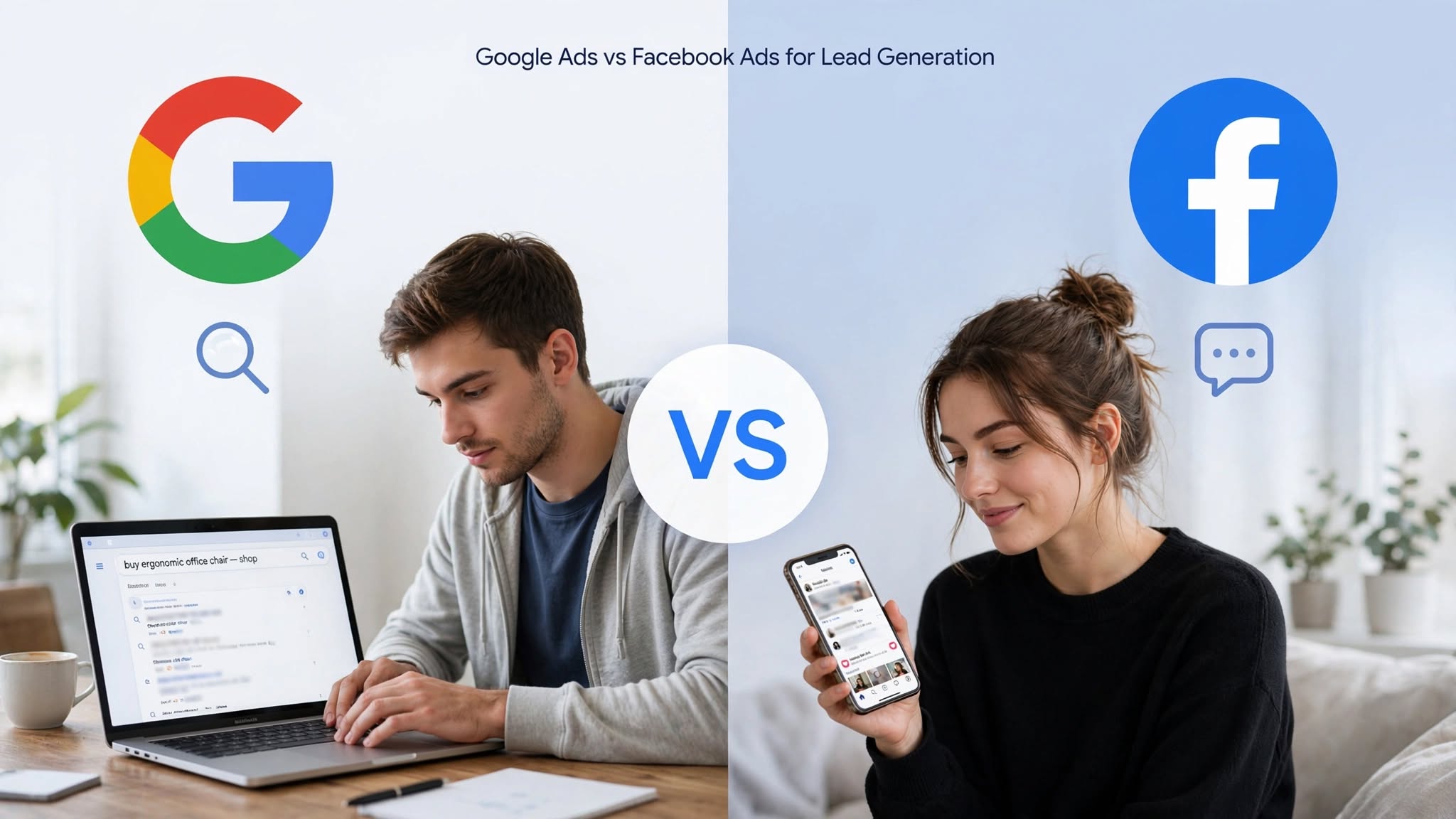
Google Ads vs Facebook Ads: The Definitive Framework for High-Ticket Lead Generation
Choosing the wrong platform can devastate your margins, resulting in thousands of dollars spent on empty clicks or low-quality form fills that drain your sales team's energy.
Data compiled across major performance networks demonstrates that while Google dominates high-intent commercial searches, Facebook captures unparalleled psychological profiling data. The fundamental distinction is not which platform is objectively superior, but rather how your specific business model aligns with user state-of-mind. Paid search targets immediate, explicit demand; paid social engineering cultivates and captures latent, interest-based opportunities.
As a premium performance marketing agency based in Santa Clarita, CA, Namaste Advertising has audited and scaled campaigns across both ecosystems. We understand that high-ticket lead generation requires a deep understanding of user behavior and platform metrics. This tactical playbook will break down the structural differences, conversion data, and algorithmic mechanics of both networks, enabling you to build a dominant, predictable growth pipeline.
1. The Intent Matrix: Capturing Demand vs. Creating Awareness
The core structural divide between Google and Facebook lies entirely within the searcher’s psychological intent. Google operates as an intent-driven pull network. When a prospect types a highly targeted keyword like “enterprise lead generation services” or “corporate tax attorney Santa Clarita,” they are actively searching for an immediate solution to an active bottleneck. They are at the bottom of the purchase funnel, ready to engage.
Conversely, Meta’s Facebook operates as an attention-disruption push network. Users do not log onto social channels to find a business vendor; they are there to consume media and interact socially. Your advertisement must break through that passive browsing behavior with arresting creative and deep psychographic positioning. You are not capturing existing market demand—you are actively introducing a problem and presenting your brand as the solution.
Critical Performance Benchmark: Across B2B and high-ticket service verticals, intent-driven traffic from Google PPC regularly generates a closing rate 2.5x to 4x higher than passive audience traffic from social platforms, though initial cost-per-click metrics may be higher.
If your enterprise sells a specialized, urgent service, Google Search ensures your ad appears at the exact millisecond of need. However, if you are bringing a highly innovative, conceptual SaaS platform or a blue-ocean service to market that users don’t know how to search for yet, Facebook’s behavioral clustering allows you to build awareness and generate highly qualified leads from scratch.
Pro Tip: Do not force a push channel to do a pull channel’s job. If budget is highly constrained, secure all high-intent search variations on Google first via exact match phrases. Use Facebook to run hyper-targeted lookalike campaigns focused strictly on prospects matching your highest-lifetime-value client profiles.
2. Cost Per Lead (CPL) Benchmarks and Cost Metrics
To make an objective decision, you must evaluate baseline cross-platform economics. Generally, Facebook Ads deliver a significantly lower cost-per-click (CPC) and a lower initial cost-per-lead (CPL) than Google Search. Meta’s massive ad inventory allows their algorithm to find lower-cost impressions, meaning your budget can buy a larger volume of raw lead submissions.
However, looking only at top-funnel metrics can be misleading. A lower CPL on Facebook often comes with a hidden downside: lower lead purity and poor sales qualification. Because Facebook Instant Forms make it incredibly easy to submit info with pre-filled profile details, users often convert with minimal friction. This can lead to incorrect phone numbers, outdated emails, and a lack of true buying intent.
Chart Specification: Cross-Platform Conversion Analytics Matrix
- Chart Type: Dual-Axis Clustered Bar and Trend Line Visualization
- X-Axis: Core High-Ticket Industries (B2B SaaS, Professional Legal, Medical/Healthcare, High-End Local Services)
- Y-Axis 1 (Bars – Blue & Navy): Cost Per Lead (CPL) in USD ($20 to $180 scale)
- Y-Axis 2 (Line – Emerald Green): Final Lead-to-Close Conversion Velocity (% Scale)
- Data Mapping Points:
- B2B SaaS: Google CPL $115, Close 8.2% | Facebook CPL $45, Close 2.1%
- Professional Legal: Google CPL $165, Close 14.5% | Facebook CPL $65, Close 3.4%
- High-End Local Services: Google CPL $75, Close 18.2% | Facebook CPL $32, Close 5.1%
- Design Layout Note: Color code Google bars as dark navy and Facebook bars as ocean blue. The emerald line clearly demonstrates that while Facebook holds the lower upfront cost edge, Google leads in overall closing efficiency.
Google Ads keywords carry a premium cost because you are bidding in a real-time auction against competitors for a hot prospect. While your initial CPL on Google may look higher on paper, your cost-per-acquisition (CPA) at the bottom of the sales funnel is often much lower because these leads have strong buying intent.
3. Audience Profiling and Algorithmic Targeting Mechanics
Meta’s primary advantage is its unmatched psychographic data ecosystem. Facebook tracks deep behavioral habits, life milestones, interest affinities, and organizational demographic layers. If your goal is to target “CEOs living within a 25-mile radius of Santa Clarita who are interested in logistics software,” Facebook can isolate that exact audience with incredible precision.
Google’s targeting focus is built heavily around user search terms, complemented by robust in-market and affinity audiences. Rather than looking closely at who the user is as an individual, Google concentrates on what that user needs at this specific moment. This approach helps you capture users right when they are making a buying decision.
Strategic Platform Capabilities Matrix
Targeting & Conversion Vector | Google Paid Search Ecosystem | Meta Facebook Paid Social Network |
Primary Target Trigger | Active keyword inputs and immediate problem-solving inquiries | Psychographic profiles, behavioral tracking, and explicit interests |
Lead Quality Profile | Exceptionally high purity; ready to buy; shorter sales cycles | Variable quality; requires multi-step nurturing and filtering |
Creative Asset Dependence | Low-to-medium; text ad copy and message match optimization | Extremely high; requires constant video/image fresh rotations |
Native Lead Solutions | Google Lead Form Extensions (integrated into search landscape) | Instant Lead Forms (frictionless native in-app conversion) |
For complex B2B sales cycles, the best approach is often to combine both platforms. You can use Google Search to capture immediate demand, and then deploy Facebook’s advanced pixel engine to retarget those high-value visitors with social proof and tailored case studies.
Pro Tip: When launching lead generation campaigns on Facebook, add custom qualification questions to your Instant Forms instead of relying solely on pre-filled data. Requiring users to type out their business email or state their primary challenge filters out casual scrollers and boosts your lead quality.
4. Advanced Native Capture Frameworks: Form Extensions vs. Instant Forms
Both platforms have introduced native lead generation tools designed to keep users inside their ecosystem. This approach bypasses standard external website landing pages altogether, eliminating friction and helping you secure lead details more efficiently.
Facebook’s Instant Forms are highly effective for mobile lead generation. When a user clicks your social ad, a fast-loading, native form opens instantly within the app. This streamlined experience makes it incredibly easy for users to submit their information, especially on mobile devices.
Infographic Description: Optimal Multi-Touch Retargeting Funnel Architecture
- Visual Layout: A progressive, linear workflow diagram moving from top to bottom.
- Stage 1 (Top): Google Search Ad captures active searchers typing high-intent commercial terms. Traffic splits into Form Completers and Landing Page Bouncers.
- Stage 2 (Middle): Bouncers enter a dedicated custom retargeting pool. The Meta Pixel triggers an interactive case-study video ad on Facebook and Instagram.
- Stage 3 (Bottom): User interacts with the Facebook Native Instant Form, passing verified contact credentials directly to your sales CRM.
- Color Code: Deep steel blue for Google Search entry points, sharp Meta violet for social nurture paths, and vibrant gold highlights for successful CRM completions.
Google has countered this with Google Lead Form Extensions, which appear directly beneath your responsive search ads on mobile and desktop layouts. While these search extensions capture high-intent leads quickly, they don’t offer the rich visual branding and storytelling capabilities of Facebook’s native instant forms.
Want us to audit your current paid acquisition campaigns?
Book a free campaign architecture strategy call at namasteadvertising.com today.
5. Designing High-Converting Creatives and Copy
On Google Search, your copy does the heavy lifting. You must optimize 15 responsive headlines and 4 descriptions around tight keyword themes. Winning the click requires direct message matching, clear differentiation, and clear dynamic calls to action. The user’s focus is on finding a fast, accurate answer to their query.
On Facebook, your visual creative is the single most important factor in your campaign’s success. Your images and videos have to stop users from scrolling past. If your creative looks like a boring, generic ad, it will be ignored. To stand out, you need high-impact hooks, real customer video testimonials, and clear benefit-driven messaging that speaks directly to the user’s challenges.
No matter which platform you choose, ensuring a strong connection between your ad messaging and your destination page is critical. If your ad performance is dipping, our specialized Google Ads engine paired with cutting-edge SEO architecture can optimize your entire post-click experience for maximum return on investment.
6. Navigating Privacy and First-Party Tracking Infrastructure
Modern privacy restrictions, such as Apple’s iOS tracking changes and the phase-out of third-party cookies, have fundamentally changed digital ad optimization. Advertisers can no longer rely on simple browser pixels to track conversions and optimize bidding algorithms accurately.
To keep your campaigns performing at their best, you need to implement first-party tracking solutions. For Google, this means setting up Enhanced Conversions to securely pass hashed user data back to the network. For Facebook, you need to integrate the Conversions API (CAPI) to send server-side event data directly to Meta’s servers.
Upgrading your data setup keeps your tracking accurate and gives AI bidding algorithms the clean data they need to perform. If your business model requires advanced lead generation, incorporating tools like AI-driven search optimization helps future-proof your account against ongoing tracking updates.
7. Scaling Your Budget with Strategic White-Label Partnerships
As your business scales, managing multi-channel ad campaigns across both platforms can quickly become overwhelming. Each network requires constant attention, from daily bid adjustments and keyword pruning on Google to ongoing creative updates and audience testing on Facebook.
For growing enterprises and busy marketing agencies, trying to handle everything internally can lead to split focus and wasted ad spend. Partnering with a specialized team allows you to scale up your capabilities without adding internal overhead.
Utilizing a premium, dedicated White Label partner framework gives you instant access to advanced optimization tools and deep channel expertise. This ensures your ad budget is working efficiently across both networks while you focus on closing deals and running your business.
8. Data-Driven Frameworks: Calculating Lifetime Value Return Formulas
To judge cross-platform performance accurately, your team must look past top-funnel metrics and calculate the true Customer Lifetime Value to Customer Acquisition Cost ratio ($LTV:CAC$). The true metric of platform success is defined by the core formula:
$$ROI_{Net} = \frac{(LTV \times \mu_{Close}) – CAC_{Raw}}{CAC_{Raw}}$$
Where $\mu_{Close}$ represents your final lead-to-close velocity percentage, and $CAC_{Raw}$ represents the raw operational capital required to secure that lead. If Facebook offers a lower upfront lead cost but converts at a significantly lower rate, its long-term financial return may lag behind a higher-cost Google Search campaign that drives highly motivated, ready-to-buy prospects.
Ultimately, a balanced, multi-channel strategy that leverages both platforms’ unique strengths will deliver the most predictable growth. By using Google to capture active buyers and Facebook to build awareness and retarget prospects, you create a resilient client acquisition engine that scales efficiently over time.
Frequently Asked Questions: Google vs Facebook Lead Generation
Which platform is better for B2B lead generation, Google Ads or Facebook Ads?
The best way to secure high-ticket B2B leads is to prioritize Google Ads due to its intent-driven framework. Google allows you to target decision-makers at the exact moment they search for business solutions, resulting in higher closing rates and shorter sales cycles compared to Facebook’s interest-based targeting.
Why is my cost per lead lower on Facebook but my sales are not increasing?
According to performance data, Facebook native instant forms reduce user friction, which lowers your upfront cost-per-lead. However, this ease of submission often attracts casual browsers with lower buying intent, requiring a robust lead-nurturing system to filter and qualify prospects effectively.
Can I combine Google and Facebook Ads for a single lead generation campaign?
In 2026, businesses should deploy a multi-channel framework that combines both platforms for maximum return. The most efficient strategy uses Google Search ads to capture immediate, high-intent traffic and Facebook Ads to retarget those visitors with social proof and tailored case studies.
How do privacy updates affect tracking across Google and Meta platforms?
Modern privacy updates require accounts to shift away from standard browser tracking. To maintain accurate data and campaign optimization, enterprises should implement Google Enhanced Conversions and Facebook Conversions API (CAPI) to pass secure, first-party data directly to both networks.
How much budget should I allocate between search and social channels starting out?
The best approach for service businesses is to allocate 60% to 70% of their initial budget to Google Ads to secure existing high-intent search traffic. The remaining 30% to 40% should be used for Facebook targeting and retargeting to build brand awareness and fill the top of your sales funnel.
Maximize Your Customer Acquisition ROI
Stop guessing which platform will perform better for your business. Building a predictable, scalable lead generation system requires a deep understanding of data, audience behavior, and modern tracking infrastructure. Whether you need to optimize high-intent search campaigns or scale your creative performance on social, partnering with a specialized team delivers the clarity and focus needed to win.
Namaste Advertising designs and scales high-performance customer acquisition engines that turn ad budget into measurable revenue. Based in Santa Clarita, California, we provide transparent, data-driven lead generation and performance marketing services that help your enterprise scale with confidence.
Ready to build a high-converting customer acquisition engine?
Contact Namaste Advertising today at (661) 888-0651 or visit our strategy center at namasteadvertising.com/contact-us/ to schedule your comprehensive cross-platform strategy consultation.