
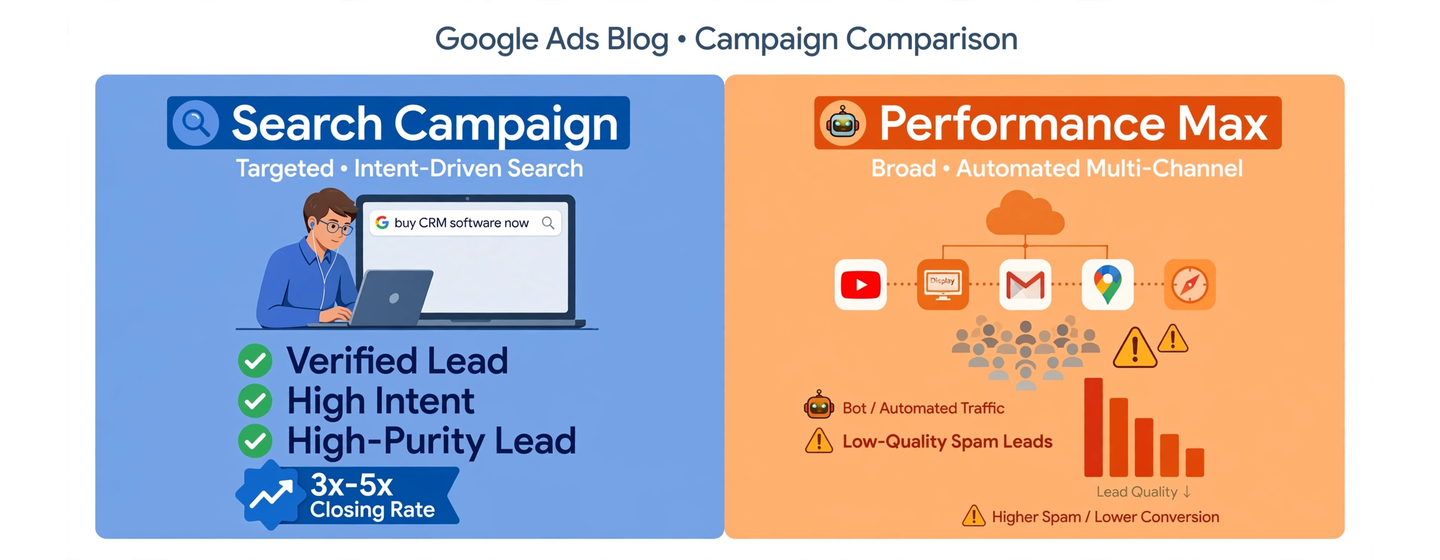
Search Campaign vs Performance Max: Which One Delivers Better Lead Quality?
This architectural standoff has redefined modern search engine marketing. Google Ads has shifted aggressively toward machine learning, automated asset blending, and algorithmic audience expansion. Traditional Search Campaigns allow you to retain strict, manual control over specific keyword match types and targeted search strings. Performance Max, by contrast, operates as a black-box, multi-channel engine that broadcasts your assets across Search, YouTube, Display, Discover, Gmail, and Maps simultaneously. While P-Max excels at gathering a massive volume of raw data for e-commerce brands, deploying it carelessly for high-ticket lead generation can easily result in a flood of un-targeted lead spam.
As a premium performance digital marketing agency based in Santa Clarita, CA, Namaste Advertising has audited and rebuilt hundreds of high-stakes customer acquisition pipelines. We understand that a lower upfront cost-per-lead is completely meaningless if those leads fail to convert into bottom-line corporate revenue. This definitive strategic playbook breaks down the structural mechanics, algorithmic variations, and actual lead-quality profiles of Search Campaigns versus Performance Max, enabling you to build a highly profitable, predictable growth engine.
1. The Quality Battle: Intent-Driven Search vs. Algorithmic Audience Disruption
The fundamental divide governing lead purity between these two campaign types traces back to user state of mind. A traditional Google Search campaign operates as an explicit intent-driven pull framework. When a prospect opens a browser and types a long-tail transactional keyword like “enterprise lead generation services” or “commercial contractor Santa Clarita,” they are actively trying to solve an immediate problem. They are at the bottom of the purchase funnel, making their downstream conversion velocity incredibly high.
Performance Max functions as an aggressive cross-channel push-and-pull hybrid. Because P-Max blends your search text with display images and video assets, it doesn’t wait for a user to search for your services. Instead, the algorithm uses predictive profiling to display your ad across the Google ecosystem—shuffling your creative into a passive user’s YouTube feed, displaying it as a banner on an external mobile app, or sliding it into a Gmail promotions tab.
Critical Performance Benchmark: Cross-industry performance audits indicate that while Performance Max can generate a raw lead volume 20% to 40% higher than standard search, traditional Search Campaigns yield a downstream sales closing rate 3x to 5x greater due to the un-diluted commercial intent of keyword-driven traffic.
When you target high-ticket service verticals or complex B2B sales cycles, capturing a casual scroller who was disrupted while watching a video rarely results in a qualified sales conversation. They lack immediate buying urgency. For high-purity customer acquisition, capturing explicit demand via strict search terms remains the more reliable methodology.
Pro Tip: If your campaign’s primary goal is to generate inbound phone calls or high-value consultation bookings, start by maximizing your impression share on exact match Search campaigns. Do not launch a Performance Max lead generation campaign unless your account has already established a clean, high-volume baseline of conversion data that the algorithm can use for audience matching.
2. The Lead Spam Vulnerability: P-Max Display Leaks vs. Keyword Control
The single largest complaint surrounding Performance Max for lead generation is its vulnerability to automated form-fill spam and click fraud. Because P-Max automatically extends your budget onto the Google Display Network and search partner sites to maximize impression delivery, your ads are frequently placed on low-tier mobile apps, gaming interfaces, and ad-heavy domains.
On these external networks, automated click bots and forced accidental finger-taps routinely trigger native form completions. Because Google’s machine learning sees these actions as successful conversions, it optimizes your campaign by finding more of these low-quality profiles. Traditional Search campaigns completely protect your budget from this loophole by allowing you to easily opt out of the Display and Partner networks, keeping your budget focused entirely on verified search results pages.
Strategic Campaign Vulnerability Matrix
Operational Vector | Traditional Google Search Campaigns | Performance Max (P-Max) Lead Engines |
Network Distribution | Isolated strictly to Google Search SERPs (Display can be fully disabled) | Broadcasts globally across Search, YouTube, Display, Discover, Maps, and Gmail |
Traffic Target Mechanism | Strict user-inputted keyword strings and match type boundaries | Asset group associations combined with automated audience signals |
Lead Spam Vulnerability | Minimum (Tightly controlled by negative keyword lists and match types) | High (Vulnerable to click-bot networks on the Display expansion path) |
Data Visibility and Control | Maximum (Full search terms visibility, manual bidding overrides, clear exclusion tools) | Restricted (Masked search term groups, automated bidding dependence) |
3. Mapping the Conversion Data Pipeline Architecture
To successfully run either campaign style without wasting your budget, you must build an advanced tracking infrastructure. Because automated bidding models rely entirely on conversion signals to figure out which audiences to target in real-time, feeding incomplete data into your campaign will cause your algorithms to fail. The diagram below maps out the precise data loop required to protect your lead generation quality.
The Clean Lead Data Feedback Engine
[STAGE 1: PAID AD CLICKS]
│
├──► Traditional Search (Exact Match Keyword Intent) ──► High Purity Traffic
└──► Performance Max (Cross-Channel Audience Push) ──► High Volume Traffic
│
▼
[STAGE 2: POST-CLICK FILTER]
│
▼
Standalone Landing Page (1:1 Attention Ratio Blocks Choice Confusion)
│
▼
User Submits Contact Credentials / Form Verification Complete
│
▼
[STAGE 3: FIRST-PARTY DATA PROCESSING]
│
▼
Google Enhanced Conversions (Securely hashes names, emails, & phone variables via GTM)
│
▼
Server-Side API Transmission (Bypasses browser blockers to deliver 100% data accuracy)
│
▼
[STAGE 4: ALGORITHMIC OPTIMIZATION]
│
▼
Smart Bidding Engine Ingests Clean Downstream Purity Signals
│
▼
Bidding Models (Target CPA) Lower Bids on Spam Vectors & Maximize Spend on True Buyers
4. Real-World Vertical Adjustments: Search vs. P-Max Realities
To see how these platform mechanics perform in action, let’s analyze two real-world case studies across different service sectors.
Scenario A: High-Ticket Professional Legal Practice
- The Goal: A corporate litigation firm wanted to secure new enterprise-level retainers. They initially launched a Performance Max campaign using text lines, images, and video explainers.
- The Problem: The campaign generated a flood of leads at a low upfront cost. However, over 90% of the leads were individuals seeking free legal aid, consumer disputes, or spam form submissions, completely overwhelming their intake staff.
- The Correction: The firm paused P-Max and launched tightly themed Search Campaigns built around transactional exact match terms like [corporate defense attorney]. They disabled search partners and added a deep campaign negative list.
- The Outcome: While the raw lead volume dropped, the firm’s conversion purity increased immediately. The intake team closed two high-value enterprise retainers within 60 days, cutting their client acquisition costs significantly.
Scenario B: Scalable Regional Home Services Contractor
- The Goal: A multi-location residential heating, cooling, and plumbing brand wanted to maximize their weekly booking volume across several local zip codes.
- The Strategy: Instead of choosing only one campaign type, they deployed a coordinated, multi-tiered framework. They used traditional Search ads and native Google Local Services Ads (LSAs) to capture urgent local searchers during peak operational hours. Concurrently, they ran a highly targeted P-Max campaign, using verified customer lists as an “Audience Signal” to display brand videos to local homeowners during shoulder seasons.
- The Outcome: This balanced strategy allowed the company to capture immediate search demand while using social retargeting to fill the top of their sales funnel, driving predictable local lead generation.
5. Post-Click Optimization: The 1:1 Attention Ratio Engine
Winning the click through precise campaign selection is only the first part of your acquisition funnel; your post-click destination experience dictates your final return on investment. If you route your paid search or cross-channel P-Max traffic directly to your corporate homepage, your conversion efficiency will drop. Homepages are designed for general brand browsing, featuring complex menus and external links that distract users from converting.
To maximize your returns, your advertising campaigns must route traffic to dedicated, single-purpose landing pages that maintain a strict 1:1 Attention Ratio. This means there is exactly one primary action for the user to take: complete your lead capture form or call your phone number. By completely removing top navigation menus and external links, you eliminate the distractions that lead to high bounce rates.
The Post-Click Journey Comparison
- The Cluttered Homepage Framework: Features 40+ clickable options, general company history, a blog feed, and social media icons. The user gets distracted, explores multiple pages, and leaves without converting. Result: 1.5% Conversion Rate.
- The Standalone Landing Page Framework: Completely isolates the user. Features a prominent, benefit-driven hero headline matching the ad copy, bold local reviews, and a short lead-capture form. Result: 8.5%+ Conversion Rate.
Are your current paid campaigns delivering low-quality spam leads?
Let our performance strategists execute a comprehensive account audit. Book a free campaign architecture call at namasteadvertising.com today.
Additionally, you must optimize your landing pages for mobile velocity. Because a substantial percentage of local service search clicks occur on mobile devices, any delay in mobile load time can cause your conversions to drop by 20%. Keep your code clean, remove heavy scripts, and ensure your forms support smartphone auto-fill to create a frictionless user journey.
6. Advanced Tracking Purity and CRM Synchronization
The ultimate winner of the Search vs. Performance Max debate depends entirely on how well you manage your tracking data. If your tracking tags only record a raw form submission as a successful conversion, both search engines and P-Max algorithms will look for more of those submissions—even if the leads are spam or bot traffic.
To stop this loop, you must implement advanced first-party tracking solutions. This includes configuring Google Enhanced Conversions to pass secure, hashed customer variables back to the network, and deploying server-side tracking pipelines to bypass modern browser restrictions.
For true optimization, integrate your CRM data directly with your Google Ads account via Offline Conversion Tracking (OCT). By passing data back to Google only when a lead is qualified by your sales team, you instruct the machine-learning bidding models to focus your budget on high-value, ready-to-buy prospects, lowering your final customer acquisition costs.
7. Building Coordinated Leverage Across Search Systems
While optimizing your paid acquisition campaigns is the fastest way to lower your customer acquisition costs, an elite digital marketing strategy should avoid managing paid search in complete isolation from your organic presence. Combining high-performing paid campaigns with a strong organic foundation creates a highly resilient customer acquisition engine.
By coordinating your paid keyword performance data with your long-term Search Engine Optimization (SEO) architecture, your business can share valuable data across channels. For instance, the exact high-converting phrases identified within your Google Ads campaigns can be used to guide your content production and local lead generation models, helping you secure sustainable organic market share.
For scaling organizations and active marketing agencies, managing these complex multi-channel workflows internally can quickly stretch team capacity. Partnering with a specialized team via a premium White-Label campaign partnership framework or custom AI-driven search optimization systems provides immediate access to advanced media testing tools and deep platform expertise, helping you maximize your total search footprint.
8. The Performance Equation: Calculating True Lead Acquisition Efficiencies
To judge your campaign strategy accurately, your team must move past surface-level metrics like Cost Per Lead ($CPL$) and analyze your actual Cost Per Acquisition ($CPA$) relative to lead quality. The mathematical relationship between your lead purity, conversion efficiency, and final client costs is defined by this core performance calculation:
$$\text{CPA}_{\text{Actual}} = \frac{\text{Cost Per Lead (CPL)}}{\text{Lead Qualification Purity Rate (LQPR)} \times \text{Sales Close Rate (SCR)}}$$
Imagine a scenario where a business deploys a multi-channel Performance Max campaign. The automated asset engine delivers a low, appealing upfront Cost Per Lead of $40.00. However, because the campaign pulls in a massive amount of un-targeted display traffic, the Lead Qualification Purity Rate sits at a low 15%. Across a standard sales close rate of 25%, the true Cost Per Acquisition sits at $1,066.66.
$$\text{CPA}_{\text{Performance Max}} = \frac{\$40.00}{0.15 \times 0.25} = \$1,066.66$$
Conversely, the exact same business launches a tightly themed traditional Search Campaign. The upfront Cost Per Lead appears higher at $90.00. However, because the campaign targets explicit keyword intent, the Lead Qualification Purity Rate rises to 70%. Across that exact same sales close rate of 25%, the final customer acquisition cost drops to $514.28—halving your acquisition costs for the exact same marketing investment.
$$\text{CPA}_{\text{Search Campaign}} = \frac{\$90.00}{0.70 \times 0.25} = \$514.28$$
This significant difference highlights why prioritizing intent-driven campaign architecture is essential. By taking complete control over your traffic filters rather than just chasing cheap raw leads, you maximize the efficiency of your budget, allowing you to secure substantially more revenue from your digital marketing spend.
Frequently Asked Questions: Search vs Performance Max
Why does Performance Max often generate a lower lead quality compared to Search campaigns?
Performance Max targets users across the entire Google ecosystem, including passive discovery channels like the Display Network and YouTube mobile feeds. This cross-channel approach often disrupts casual browsers who lack immediate buying intent, resulting in lower lead purity and higher form-fill spam compared to intent-driven Search campaigns.
When should a service business choose to utilize a Performance Max campaign?
Performance Max should only be deployed for lead generation once an account has already established a clean, high-volume baseline of monthly conversion data through traditional Search campaigns. This historical data provides the algorithm with the clear conversion signals required to find high-quality audience profiles across other channels.
Can I run a Performance Max campaign that targets only the Google Search network?
Performance Max campaigns cannot be natively restricted to run exclusively on the Search network, as the algorithm is designed to automatically expand your reach across all Google asset channels. If you want to restrict your budget entirely to search queries, you should build a traditional Search campaign and manually disable partner networks.
How does an unoptimized landing page impact our automated campaign bidding models?
A slow or cluttered landing page directly hurts your campaign data purity. Google’s machine learning models require clear, consistent conversion signals to optimize bidding; a messy post-click experience causes high bounce rates and erratic conversions, confusing the automated bidding algorithms and raising your acquisition costs.
How often should our team review and adjust our account’s negative keyword lists?
The best practice for active performance campaigns is to audit your search terms report and adjust your negative keyword lists weekly. Consistent maintenance allows your team to identify low-intent search variations, extract them from your ad groups, and protect your daily budget for high-converting queries.
Reclaim Your Budget and Maximize Your Marketing ROI Today
Stop letting automated campaign defaults and low-quality form-fill spam exhaust your corporate advertising capital. Navigating the modern Search vs. Performance Max landscape requires a technical, data-driven approach focused on clean tracking infrastructure, precise keyword intent, relevant ad assets, and optimized post-click experiences. If your internal team lacks the time or specialized data engineering resources to continuously monitor and tune these account metrics, partnering with an experienced performance agency is the fastest way to stabilize your acquisition costs and protect your margins.
Namaste Advertising designs, manages, and scales high-performance customer acquisition engines that transform paid search traffic into predictable streams of business revenue. Whether you are an enterprise operating locally in Santa Clarita, California, or an agency looking to expand your capabilities via a dedicated White-Label campaign partnership framework, our team delivers deep analytical transparency, validated tracking implementations, and dominant marketing returns.
Ready to Eliminate Lead Spam and Maximize Your Acquisition Quality?
Contact Namaste Advertising today at (661) 888-0651 or visit our strategy center at namasteadvertising.com/contact-us/ to schedule your comprehensive, data-driven PPC account audit and custom lead generation consultation.