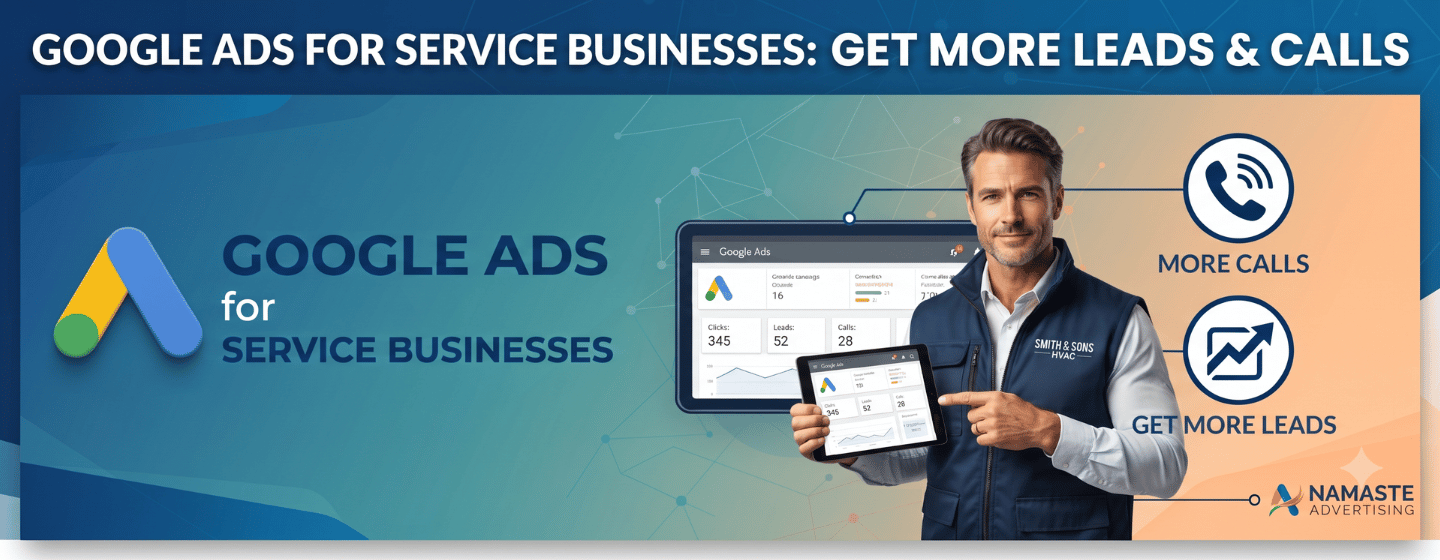
Google Ads for Service Businesses: Proven Strategies to Get More Calls & Leads
Data across premium marketing performance networks demonstrates that while Google Ads for service businesses is one of the fastest ways to secure immediate, bottom-funnel buying intent, it is also a landscape where unoptimized budgets disappear quickly. Because search engine auctions operate in real time, bidding blindly on loose keywords or routing high-intent mobile users to a cluttered, slow corporate homepage will trigger high bounce rates, leaving you with expensive invoices and an empty sales pipeline.
As a premium performance digital marketing agency based in Santa Clarita, CA, Namaste Advertising has audited, engineered, and scaled customer acquisition engines for service companies across North America. This definitive playbook breaks down the exact campaign architectures, advanced local targeting settings, call tracking parameters, and post-click environments required to stop budget waste and maximize your inbound lead volume.
1. The Intent Matching Framework: Filtering Casual Browsers from High-Intent Buyers
The fundamental error most service business owners make when launching pay-per-click campaigns is bidding on keywords that are far too broad. If an electrical contracting company bids on the broad match keyword electrical outlets, they are actively paying for informational traffic. Their ad will trigger when a homeowner searches for “how to wire an electrical outlet DIY.” You pay for the click, the user immediately leaves because they wanted a free video tutorial, and your conversion rate drops.
To protect your growth capital, your campaign architecture must prioritize explicit, commercial search intent. This requires transitioning away from loose, unmonitored broad match keywords and restructuring your ad groups around Phrase Match and Exact Match strings that incorporate high-intent buyer modifiers (such as “emergency repair,” “service provider near me,” “licensed contractor,” or “commercial consultant”).
Critical Performance Benchmark: Historical account data shows that switching from standard broad match terms to tightly controlled phrase and exact match strings reduces upfront wasted ad spend by up to 35%, while instantly increasing downstream lead purity and sales conversion velocity.
Furthermore, a truly optimized search campaign relies heavily on what you choose not to target. Before scaling any service ad budget, you must build comprehensive, campaign-level negative keyword lists to permanently block job seekers, researchers, students, and low-budget searchers. Your negative lists should explicitly exclude phrases containing words like “free,” “definition,” “salary,” “jobs,” “course,” or “cheap.”
Pro Tip: Regularly review your account’s search terms report. If you spot search queries that indicate a user is looking for a career, a diagnostic diagram, or a cheap alternative, extract those phrases and add them as negative exact match terms immediately to ensure your daily budget is reserved exclusively for ready-to-buy prospects.
2. Navigating the Native Service Landscape: Integrating Local Services Ads (LSAs)
For localized service businesses, home service companies, and specific professional practices, standard text-based search ads should not be your only acquisition channel. To fully dominate your local market, you must integrate your standard campaigns with Google’s native, pay-per-lead ecosystem: Google Local Services Ads (LSAs).
LSAs appear at the absolute top of the search engine results page, positioned securely above traditional paid text advertisements and organic map listings. These ads feature the highly trusted “Google Screened” or “Google Guaranteed” badge, instantly building psychological trust with local searchers. More importantly, the financial dynamic shifts entirely: instead of paying for a click that may bounce, you pay exclusively for valid phone calls or direct message leads generated within your service area.
Strategic Acquisition Channel Matrix
Operational Vector | Google Local Services Ads (LSAs) | Traditional Google Search Ads (PPC) |
Billing Model | Pay-Per-Lead / Pay-Per-Call (Only pay for verified inquiries) | Pay-Per-Click (Pay for every user who visits your landing page) |
SERP Positioning | Absolute top visual real estate (Above traditional text ads) | Prime real estate (Directly below LSAs or generative answers) |
Targeting Mechanism | Selected category settings and physical local zip codes | Comprehensive keyword strings, match types, and audiences |
Fulfillment Link | Direct phone call or platform-native text interface | Redirects users to an external standalone landing page |
By combining standard search campaigns with an optimized Local Services Ads (LSA) framework, your business can capture multiple spots at the top of the search page. This approach maximizes your brand’s visibility and allows you to capture urgent, mobile searchers at the exact millisecond they need a service provider.
3. Mapping the Inbound Service Funnel Architecture
To successfully scale a service-based ad campaign, you must view the customer journey as a structured, multi-touch system designed to turn raw search queries into booked service appointments. The funnel architecture below maps out the precise path high-intent prospects follow through an optimized acquisition pipeline.
The Service Lead & Call Generation Funnel
[STAGE 1: HIGH-INTENT CAPTURE]
│
▼
Active Search Query (e.g., “Commercial HVAC Repair Santa Clarita”)
│
├──► Google LSA Placement (Pay-Per-Call Engine) ──► Direct Phone Call
│
└──► Google Search Text Ad (Phrase/Exact Match)
│
▼
[STAGE 2: POST-CLICK CAPTURE]
│
▼
Standalone Landing Page (1:1 Attention Ratio)
│
├──► Sticky Mobile Click-to-Call Button
│
└──► High-Conversion Smart Lead Form
│
▼
[STAGE 3: CRM INTEGRATION]
│
▼
Hashed Conversion Data Pipeline
(Google Enhanced Conversions via GTM)
│
▼
[STAGE 4: AUTOMATED OPTIMIZATION]
│
▼
Smart Bidding Machine Learning Tunes
Real-Time Auction Bids for Ideal Profiles
4. Real-World Service Industry Blueprints and Performance Examples
To demonstrate how this campaign structure works across different sectors, let’s look at two specific, data-backed operational blueprints designed for distinct service business models.
Example A: High-Ticket B2B Commercial Contractor
- The Challenge: A commercial roofing and waterproofing contracting firm struggles with a high cost-per-lead because their search ads are landing on a generic homepage, mixing up residential repair requests with high-value commercial property managers.
- The Correction: The team builds a dedicated campaign that explicitly excludes terms like “house,” “residential,” “shingle,” or “DIY” via campaign negative lists. They route all paid traffic to a dedicated commercial landing page that has all navigation links removed, features prominent trust badges, and highlights past enterprise case studies.
- The Outcome: The campaign achieves a clean 8.4% landing page conversion rate, successfully isolating high-value facility directors and commercial property leads while reducing residential budget waste to 0%.
Example B: High-End Local Home Services Provider
- The Challenge: A specialized, multi-location plumbing and HVAC provider notices their mobile click costs are rising, but their internal office staff isn’t receiving enough direct phone calls during operational hours.
- The Correction: The team implements strict ad scheduling to ensure their ads only run when the office is fully staffed to answer the phone. They configure prominent click-to-call assets across their mobile responsive ad layouts and add a sticky, floating call button to the header of their mobile landing pages.
- The Outcome: Inbound phone calls increase by 45% within the first 30 days, lowering their average client acquisition cost by leveraging high-urgency mobile search behaviors.
5. Post-Click Optimization: The 1:1 Attention Ratio Rule
Your ad copy and keyword selection are responsible for winning the click; your landing page is entirely responsible for winning the lead. If you direct high-cost paid traffic to a standard corporate homepage, your conversion rates will suffer. Homepages are built to encourage multi-page exploration, featuring complex menus, social icons, and team bios that distract users from converting.
To maximize your returns, your paid campaigns must route users to dedicated, single-purpose landing pages that maintain a strict 1:1 Attention Ratio. This means there is exactly one primary action for the user to take: fill out your lead form or call your phone number. By completely stripping away the main navigation menus and external links, you eliminate the distractions that lead to high bounce rates.
The Post-Click Journey Framework
- Visual Concept: A comparison between a cluttered homepage and an optimized landing page.
- The Cluttered Homepage (The Budget Leak): Features 40+ clickable links, general company history, a blog feed, and social media badges. The user gets distracted, browses multiple pages, and leaves without converting. Result: 1.8% Conversion Rate.
- The Optimized Landing Page (The Conversion Capsule): Completely removes the main header and footer menus. Features a prominent, benefit-driven hero headline matching the ad copy, bold social proof, and a clear call-to-action form. Result: 9.5% Conversion Rate.
Are your current paid acquisition campaigns failing to drive actual phone calls?
Let our performance strategists audit your account. Book a free strategy call at namasteadvertising.com today.
Additionally, you must optimize your pages for mobile speed. Over 65% of local service search clicks happen on mobile devices. If your landing page takes longer than 2.5 seconds to render on a smartphone, users will immediately click away. Keep your conversion paths simple, lightweight, and frictionless.
6. Advanced call Tracking and Clean GA4 Event Architecture
To optimize your service business campaigns effectively, your team must move beyond superficial click metrics and look closely at downstream lead quality. If you track only raw clicks, you cannot see which specific keywords are driving actual, high-value customer phone calls.
Implementing advanced call tracking software (such as CallRail or Google’s native forwarding system) dynamically replaces the phone number on your landing page based on the visitor’s search origin. This tracking allows you to attribute every inbound call directly back to the specific keyword, campaign, and ad copy variation that generated the inquiry, helping you see exactly which terms drive the best leads.
Furthermore, you must pass this conversion data cleanly back to your ad networks via tools like Google Enhanced Conversions and the GA4 event stream. Feeding clean, un-diluted conversion signals back into your account allows Google’s automated smart bidding models (like Target CPA) to optimize effectively, lowering your average cost-per-lead over time.
7. Driving Growth with Scalable White-Label Agency Partnerships
Consistently managing and optimizing multi-channel ad campaigns across different service categories requires substantial technical analysis, regular copy testing, and ongoing data monitoring. For growing enterprises and active marketing agencies, handling these workflows internally can stretch team capacity and lead to campaign inefficiencies.
Partnering with an experienced performance marketing team allows your business to scale up its digital advertising capabilities without adding fixed internal overhead. This ensures your accounts receive constant optimization while your leadership team focuses on closing deals and running core business operations.
Using a premium, dedicated White-Label campaign partner framework or custom Lead Generation solutions provides immediate access to specialized platform experts, advanced tracking configurations, and clean reporting dashboards, helping you extract maximum return from every dollar of ad spend.
8. The ROI Blueprint: Coordinating Paid Media and Organic Systems
To build a truly resilient digital presence, your business should avoid managing paid ads in complete isolation from your organic presence. While paid search serves as an excellent tool for generating immediate lead volume, combining it with long-term organic growth creates a highly stable customer acquisition engine.
By coordinating your paid keyword insights with your long-term Search Engine Optimization (SEO) architecture, your business can share valuable data across channels. For instance, the exact high-converting phrases identified within your Google Ads campaigns can be used to guide your content production and site structure, helping you secure sustainable organic market share.
Integrating advanced strategies like AI-driven search optimization ensures your brand remains visible across both traditional sponsored auctions and evolving generative search layouts, maximizing your total digital footprint and lowering your long-term customer acquisition costs.
Frequently Asked Questions: Google Ads for Service Businesses
Why should our service business prioritize Google Ads over standard social media platforms?
Google Ads operates as an intent-driven pull network, displaying your business to high-intent prospects at the exact millisecond they search for a service solution. Social media platforms operate as attention-disruption networks where users browse passively, making paid search significantly more efficient for generating urgent, bottom-funnel phone calls and leads.
What is the baseline conversion rate milestone for a service company’s landing page?
While the average conversion rate across all combined industries sits at 4.40%[cite: 1], top-performing service accounts using dedicated landing pages routinely hit conversion rates between 8% and 15%. Achieving this milestone requires removing global navigation menus, utilizing clear message matching, and keeping mobile forms simple and short.
How do Google Local Services Ads (LSAs) differ from traditional Google Search ads?
The primary difference lies within the billing and conversion framework. Traditional search ads utilize a pay-per-click model where you pay for every user who visits your landing page, regardless of action. Local Services Ads (LSAs) utilize a pay-per-lead framework where you are billed exclusively for verified phone calls or direct message inquiries.
Can a slow landing page impact our campaign’s cost-per-click performance?
A slow website page directly impacts your campaign efficiency. Google’s quality score algorithm actively analyzes your landing page load speed and user experience; a slow or unoptimized post-click destination lowers your overall quality scores, which drives up your actual cost-per-click and rewards competitors with premium ad positioning.
How long does it take for a new campaign to deliver stable lead generation results?
While initial lead data can record within 48 hours of campaign launch, Google’s smart bidding models typically require 30 to 45 days of steady data collection to fully navigate the automated learning phase, accurately identify high-intent target profiles, and deliver a stable, optimized cost-per-acquisition.
Take Back Control of Your Marketing Capital Today
Stop letting unoptimized campaigns, loose keyword match types, and complex homepage layouts exhaust your corporate advertising capital. Building a highly profitable customer acquisition engine for a service business requires a technical, data-driven approach focused on clean tracking infrastructure, precise keyword intent, relevant ad assets, and optimized post-click experiences. If your internal team lacks the time or specialized engineering resources to continuously monitor and tune these metrics, partnering with an experienced performance marketing team is the fastest way to stabilize your acquisition costs and protect your growth margins.
Namaste Advertising designs, manages, and scales high-performance customer acquisition engines that transform paid search traffic into predictable streams of business revenue. Whether you are an enterprise operating locally in Santa Clarita, California, or an agency looking to expand your capabilities via a dedicated White-Label campaign partnership framework, our team delivers deep analytical transparency, validated tracking implementations, and dominant marketing returns.
Ready to Scale Your Service Business Lead and Call Volume Profitably?
Contact Namaste Advertising today at (661) 888-0651 or visit our strategy center at namasteadvertising.com/contact-us/ to schedule your comprehensive, data-driven PPC account audit and custom lead generation consultation.