
Every day, businesses waste thousands of dollars on Google Ads campaigns that generate clicks but deliver unqualified leads. The problem isn’t with the platform, it’s with the approach. Most companies focus on driving traffic volume instead of attracting genuinely interested prospects who are ready to buy.
Successful Google ads lead generation requires a strategic approach that focuses on quality over quantity. When executed correctly, Google Ads can become your most reliable source of qualified leads, with businesses reporting conversion rates of 3.75% for search campaigns and cost-per-lead reductions of up to 47%.
This guide will walk you through a proven four-step system for generating high-quality leads that your sales team actually wants to follow up with.
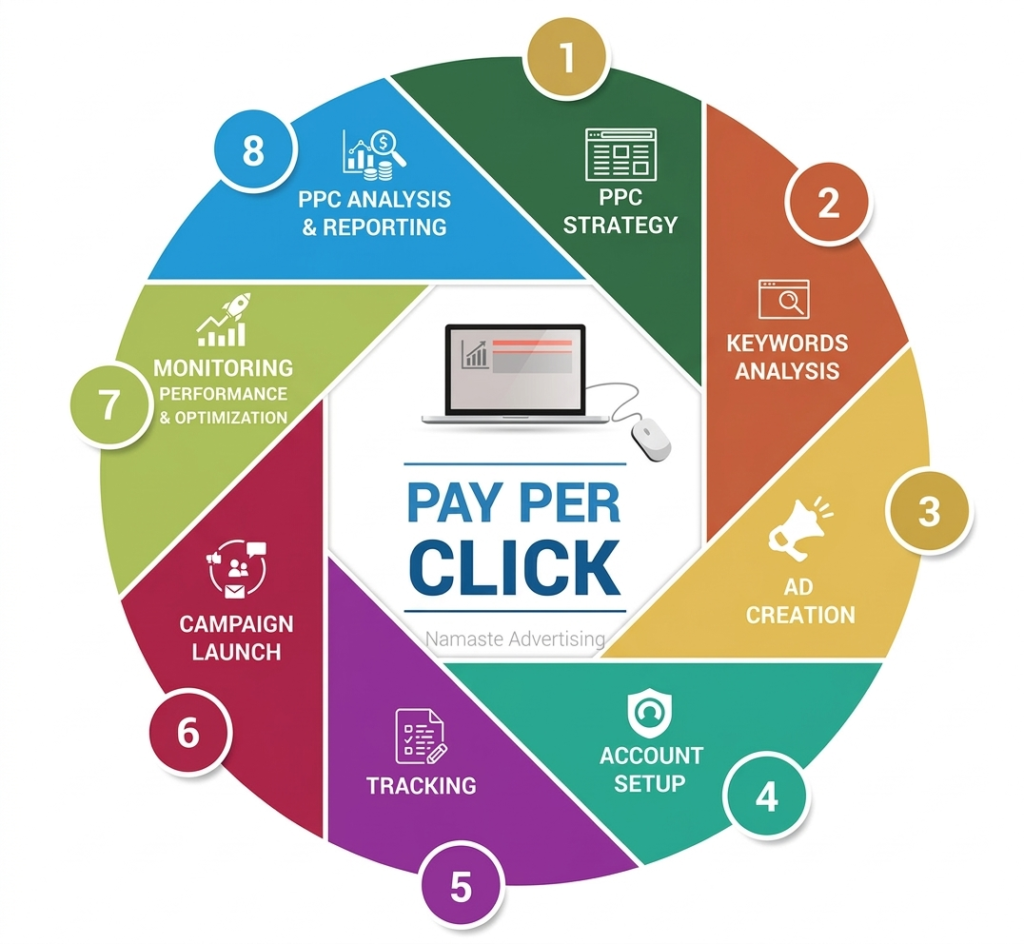
Add Alter Tag Below – Pay Per Click By Namaste Advertising ( Add link for services)
Why Google Ads for Lead Generation Works?
Google processes over 8.5 billion searches daily, with 46% of those searches having commercial intent. This means nearly half of all Google users are actively looking for products or services to purchase. When you understand how to position your business in front of these high-intent searchers, Google ads for lead generation become incredibly powerful.
The key advantage lies in timing. Unlike social media advertising where you interrupt people during leisure activities, Google Ads connects you with prospects who are actively searching for solutions. This intent-driven approach naturally produces higher-quality Google leads because you’re reaching people at the exact moment they need your service.
Step 1: Create Targeted Lead Generation Ads
The foundation of effective lead generation ads starts with keyword selection based on commercial intent. Instead of bidding on broad terms like “marketing software” that attract researchers, focus on specific phrases that indicate buying readiness.
Target keywords with modifiers like “for small business,” “pricing,” “cost,” or “near me.” These long-tail variations typically cost 30% less per click while delivering 2.5x higher conversion rates. For example, a digital marketing agency might target “SEO services for e-commerce stores” instead of the generic “SEO services.”
Your ad copy should follow a 3 component formula:
- Identify the pain point,
- Present solution,
- Highlight your differentiator.
A winning headline might read: “Struggling with Low Website Traffic? Our SEO Experts Increase Organic Leads by 150% in 90 Days.”
Use Ad extensions strategically to increase your click-through rate and provide additional value.
Sitelink extensions can direct users to specific service pages, while callout extensions highlight unique selling points like “Free Consultation” or “24/7 Support.”
Step 2: Optimize Your Google Leads Strategy
The key to generating valuable Google leads lies in understanding your target audience’s search intent and matching it with relevant landing experiences. This means creating separate campaigns for different stages of the buyer’s journey.
Implement negative keywords aggressively to filter out unqualified traffic. Common negative keywords for B2B lead generation include “free,” “cheap,” “DIY,” and “jobs.” This simple step can reduce your cost-per-lead by 25% while improving lead quality scores.
- Use audience targeting to layer additional qualification criteria.
- Combine in-market audiences with demographic targeting to reach decision-makers in your ideal customer profile.
- For B2B campaigns, target job titles, company sizes, and industry verticals that align with your best customers.
Step 3: Implement Google Ads Lead Form Extension
Using Google ads lead form extension can increase your lead capture rate by up to 30% by reducing friction in the conversion process. These forms appear directly within the ad, allowing users to submit their information without leaving Google’s search results page.
The key to successful lead forms is asking for the right amount of information. Google researchers show that forms with 3-4 fields generate 25% more leads than longer forms, while still providing enough data for qualification. Essential fields typically include name, email, phone number, and company size or specific need.
Customize your form questions based on your sales process requirements. If your sales team needs to know the budget range or timeline, include these as dropdown options rather than open text fields. This makes completion easier while gathering qualification data.
Set up proper lead routing to ensure fast follow-up. Integrate your lead forms with your CRM system for automatic lead distribution and immediate notifications.
Step 4: Track ROI and Optimize Performance
Measuring success in Google ads lead generation goes beyond click-through rates and cost-per-click. Focus on metrics that directly impact revenue: cost-per-lead, lead-to-customer conversion rate, and customer lifetime value.
Set up conversion tracking for multiple actions, including form submissions, phone calls, and email sign-ups. Many businesses miss 30-40% of their actual conversions by only tracking online form fills and ignoring phone leads generated by their campaigns.
Calculate your maximum cost-per-acquisition by working backward from your average customer value. Use this data to optimize your campaigns systematically. Increase budgets for campaigns generating leads below your target cost-per-acquisition. Pause or restructure campaigns that consistently exceed your maximum acceptable cost.
Start Generating Quality Leads Today
Implement these 4 steps to turn your Google Ads campaigns into high-quality lead generators not just traffic drivers. Focus on better leads that actually convert into paying customers.
Start with keyword research and competitor analysis, and optimize one campaign at a time for best results. With consistent execution, you can improve lead quality and ROI within 30 days.
Ready to scale your results? Start with Step 1 today and for expert help with Google Ads, CONTACT US